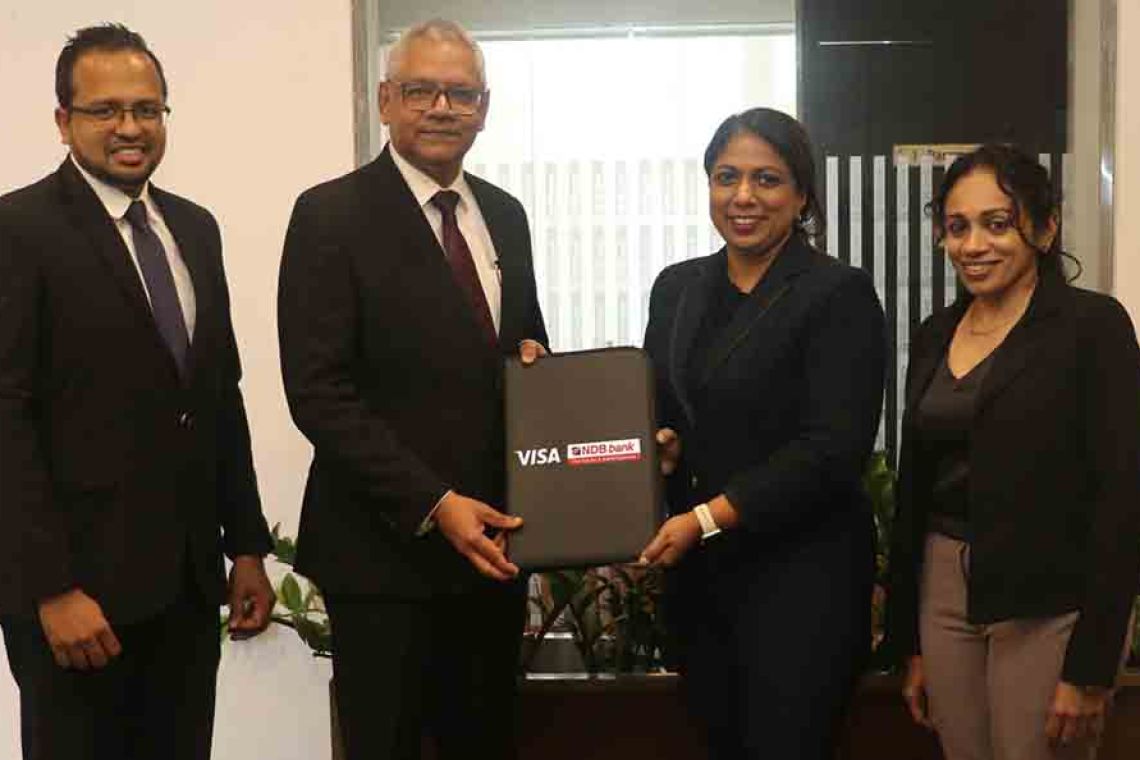
National Development Bank PLC (NDB Bank), together with Visa, a global leader in digital payments, has launched Card Present Connect (CPC), an in-person digital payment acceptance solution powered by Cybersource, Visa’s open payment platform that supports both online and offline transactions.
As one of the leading global payment gateways within Visa Acceptance Solutions for businesses, Cybersource enables secure payment processing across international card schemes.
Through this collaboration, NDB Bank introduces a reliable and future-ready payment acceptance solution to small and medium-sized businesses in Sri Lanka, making in-person card payments more efficient and secure through CPC.
The launch marks the first implementation of Card Present Connect within Visa’s South Asia market, positioning NDB Bank at the forefront of next-generation acquiring solutions in the region.
The solution enables businesses to accept EMV chip, contactless, and mobile wallet payments using Android SmartPOS devices, low-cost card readers, or tap-to-phone technology—offering a modern and flexible alternative to traditional point-of-sale systems.
For merchants, this translates into lower costs, faster onboarding, enhanced security, and improved access to both local and international customers, supporting their ability to compete and grow in increasingly cashless economies.
From an acquiring perspective, the solution delivers enhanced cost efficiency, faster go-to-market capabilities, and simplified deployment through Visa’s pre-integrated partner ecosystem.
By eliminating the need to build and maintain complex in-house payment infrastructure, the platform enables acquiring banks such as NDB to scale efficiently while maintaining full compliance, reliability, and security.
Sanjaya Perera - Senior Vice President Personal Banking & Customer Experience at NDB, added,
“Our expansion into in-person digital payments acceptance marks an important step in supporting local entrepreneurs and mid-market enterprises.
With Visa’s global technology and NDB Bank’s strong local relationships, we are delivering the next generation of payment acceptance that is seamless, secure, and sustainable.
This initiative empowers businesses with innovative solutions that simplify transactions, reduce operational costs, and enhance customer experience.
Through collaborations like this, we reaffirm our commitment to driving financial inclusion and fostering economic growth for Sri Lanka’s vibrant business community.”
Avanthi Colombage, Country Manager for Sri Lanka and Maldives, Visa, said,
“We are pleased to partner with NDB Bank to bring yet another breakthrough solution by Cybersource, that can accelerate the growth trajectory of the Sri Lankan business community.
For SMBs, traditional POS terminals can be expensive, complex, or tied to long-term contracts.
This in-person digital payment acceptance solution bridges that gap by streamlining merchant onboarding, improving operational efficiency and reducing infrastructure dependency for acquiring banks.
By helping NDB Bank expand from online to in-person acceptance, we are democratizing card acceptance and enabling merchants of all sizes with the tools, technology, and trust they need to thrive in an increasingly cashless economy.
This collaboration reflects Visa and NDB Bank’s shared vision of advancing inclusive digital payments in Sri Lanka and building a financial ecosystem that sustains this agenda well into the future.”
Together Visa and NDB Bank are redefining Sri Lanka’s acquiring landscape by democratizing card acceptance, enhancing merchant agility, and enabling faster, more inclusive access to digital payments across the country.
About Visa Inc.
Visa (NYSE: V) is a world leader in digital payments, facilitating transactions between consumers, merchants, financial institutions and government entities across more than 200 countries and territories.
Our mission is to connect the world through the most innovative, convenient, reliable and secure payments network, enabling individuals, businesses and economies to thrive.
We believe that economies that include everyone everywhere, uplift everyone everywhere and see access as foundational to the future of money movement.
Learn more at Visa.com.
About NDB Bank.
NDB Bank is the fourth-largest listed commercial bank in Sri Lanka.
NDB was named Sri Lanka's Best Digital Bank for SMEs at Euromoney Awards for Excellence 2025 and was awarded awards Domestic Retail Bank of the Year – Sri Lanka and Islamic Banking Initiative of the Year – Sri Lanka at the Asian Banking & Finance Retail Banking Awards 2025.
NDB is the parent company of the NDB Group, comprising capital market subsidiary companies, together forming a unique banking and capital market services group.
The Bank is committed to empowering the nation and its people through meaningful financial and advisory services powered by digital banking solutions.