
Solar Power Industry at Risk as New Policy Threatens to Undermine Progress on Energy Security
Sri Lanka’s solar power industry is facing a serious setback, raising concerns over the country’s energy security, business competitiveness and consumers’ ability to access lower-cost electricity.
Sri Lanka is still in the process of recovering from an economic crisis, making energy security a critical pillar of the country’s economic stability, with the country’s electricity crisis having not yet been fully resolved.
The Public Utilities Commission of Sri Lanka (PUCSL) and the National System Operator (NSO) have already warned of a serious risk of a massive electricity shortage of 450 MWh by the first half of 2027.
Today, rooftop solar power systems contribute more than 2,600 MW of capacity to the national electricity grid.
Through this contribution, Sri Lanka’s local solar energy industry is estimated to save the country approximately Rs. 20.4 billion in foreign exchange each month that would otherwise be spent on imported fossil fuels.
This amounts to savings of approximately Rs. 1.5 billion per day.
If the same volume of electricity had to be generated using diesel, the Government would have to spend approximately Rs. 2.5 billion per day.
At a time when many countries around the world have stopped providing financing for coal-fired power plants, the absence of solar power could force Sri Lanka to once again depend heavily on diesel-generated electricity, at a staggering cost of approximately Rs. 170–180 per unit.
New Policy Raises Concerns -The issue began with a new circular issued by the Ministry of Energy on 11 September 2026.
Under the new circular, the previously successful Net Metering and Net Accounting schemes have been discontinued. Instead, all new connections and extensions of existing agreements are required to operate under the Net Plus scheme.
The agreement period, which had previously been as long as 20 years, has also been reduced to a maximum of 12 years.
The financial impact on consumers is substantial.
Typically, a consumer invests around Rs. 1.5 million to Rs. 2 million to install a rooftop solar system with the objective of reducing their electricity bill to zero.
Under the previous system, a 5 kW system generating approximately 550 units could offset the 550 units consumed by the household, effectively bringing the electricity bill down to zero.
Under the new Net Plus scheme, however, the consumer would first sell the 550 units generated to the Government for approximately Rs. 13,000.
The consumer would then have to purchase the 550 units required for household consumption from the Government at the prevailing electricity tariff, at a cost of approximately Rs. 47,000–48,000.
Receiving Rs. 13,000 and subsequently paying approximately Rs. 48,000 to purchase back the electricity generated by one’s own system is not considered a practical arrangement.
With electricity tariffs in Sri Lanka increasing by approximately 5% to 7.5% annually, the policy effectively undermines the consumer’s ability to generate and use their own electricity.
Businesses Face Higher Energy Costs and Reduced Choice -The impact of the policy extends beyond individual consumers to businesses across the country.
Businesses that could otherwise invest in rooftop solar to reduce their electricity costs and improve long-term energy security may no longer have the same opportunity to select the most economically viable energy option for their operations.
Where businesses are unable to adopt or expand rooftop solar under viable commercial arrangements, they will remain dependent on electricity purchased from the national grid.
This exposes businesses to prevailing and potentially rising grid electricity tariffs, while limiting their ability to manage one of their key operating costs through investment in renewable energy.
The industry further argues that restricting consumers’ ability to choose how they generate and consume electricity raises fundamental concerns about consumer rights.
It is also viewed as being inconsistent with the basic principle of least-cost electricity embodied in Sri Lanka’s Electricity Act, under which electricity supply and generation should be pursued in an economically efficient manner.
Rather than limiting access to a lower-cost renewable energy option, stakeholders argue that consumers and businesses should be allowed to select the electricity arrangement that best meets their requirements, subject to appropriate technical safeguards and grid-management requirements.
Industry Questions Rationale Behind Policy Change - Authorities have justified the decision on the grounds that excessive solar capacity has already been added to the national grid and that the system must therefore be balanced.
However, the industry argues that this reasoning is contradictory.
If the fundamental concern is excess electricity being added to the grid, shifting consumers to Net Plus would not resolve the issue, as electricity generated through Net Plus systems would still be fed into the national grid.
Dr. Lakmal Fernando, Vice President of the Sri Lanka National Chamber of Commerce, has alleged that the decision is the result of a conspiracy involving former Ceylon Electricity Board officials favouring diesel power plants and the so-called diesel mafia.
Instead, he proposes that if grid balancing is the concern, the solution should be to strengthen the grid rather than discourage rooftop solar.
Of the approximately 33,000 transformers in Sri Lanka, batteries could be installed in the 1,000–2,000 most heavily utilised transformers to store excess solar electricity generated during the daytime and release it to the grid during the night.
Thousands of Jobs and Existing Investments at Risk-If the new policy is implemented, more than 800 companies currently operating in the solar power sector could be forced to close, potentially putting more than 21,000 jobs at risk.
The impact would extend beyond the industry itself.
Approximately 166,000 consumers who have already obtained bank loans to install rooftop solar systems could also face serious financial difficulties.
If a significant number of solar companies collapse, there could also be no viable industry capacity to maintain the more than 2,600 MW of solar systems already installed across the country.
Against this backdrop, President of the Sri Lanka National Chamber of Commerce Anura Warnakulasuriya recently wrote to President Anura Kumara Dissanayake on 23 September 2026, making two key requests.
These are to immediately revoke the Ministry directive dated 11 September and reinstate Net Metering and Net Accounting, and to make it mandatory for any future policy changes to be evaluated by the independent regulator, the Public Utilities Commission of Sri Lanka (PUCSL).
Solar industry representatives have also written to all 225 Members of Parliament to raise awareness of the issue.
Industry Proposes Alternative Solutions - Solar industry representatives have submitted a series of practical proposals to the Government aimed at protecting the sector and addressing concerns surrounding grid stability.
A key proposal is to allow consumers to select the commercial model that best suits their electricity consumption patterns, rather than making Net Plus compulsory.
Consumers should be given the option of Net Metering or Net Accounting, depending on their requirements.
The industry has also proposed encouraging the use of Battery Energy Storage Systems (BESS) alongside solar installations.
This would allow excess electricity generated during the daytime to be stored and subsequently used during periods of peak electricity demand at night, helping maintain stability across the national grid.
In addition, the national grid’s transformers and distribution networks should be upgraded to ensure that sufficient capacity is available before further rooftop solar systems are connected.
The country should also move towards smart-grid technology to improve the management of distributed renewable energy.
A Critical Crossroads for Sri Lanka’s Energy Future - The industry warns that unilateral policy decisions made without independent regulation are undermining investor confidence and limiting the ability of consumers and businesses to make their own energy choices.
At a time when Sri Lanka continues to navigate economic recovery and faces potential risks to its electricity supply, stakeholders argue that protecting the country’s renewable energy capacity, maintaining consumer choice and ensuring access to least-cost electricity will be critical to long-term energy security and economic competitiveness.
Unless immediate attention is given to the concerns raised by the industry, Sri Lanka risks moving away from an energy source that can reduce dependence on imported fossil fuels and help businesses and consumers manage electricity costs, while increasing its exposure to expensive diesel-generated power.
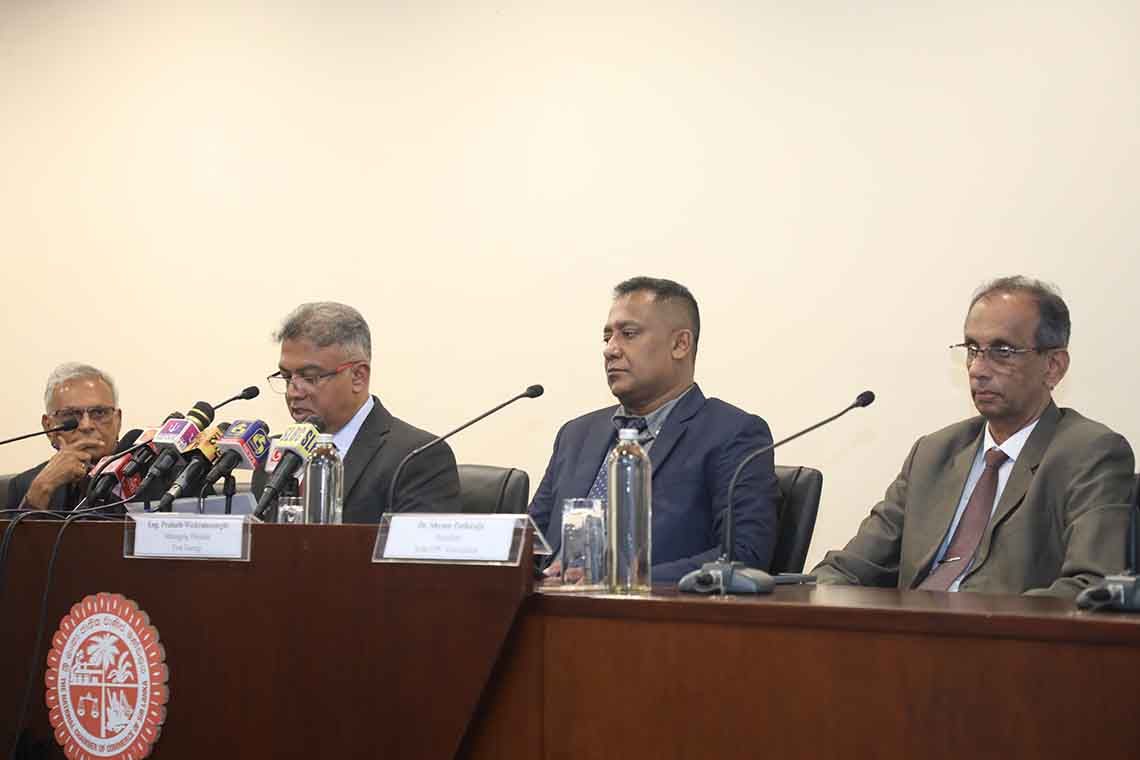
Photo caption - Industry experts and stakeholders share their views during the panel discussion on “Affordable Clean Energy – A Right, Not a Privilege.”
Latest Posts











Video

K9 unit flown by Emirates SkyCargo to Zimbabwe begins frontline operations
Vega and Kuda, two specialist conservation dogs, transported by Emirates SkyCargo from London to Harare via Dubai in partnership with UK charity Dogs 4 Wildlife, have arrived safely and acclimatise