EV Batteries vs ICE Engines : Evolution Auto Reframes the Longevity Debate
As Sri Lanka’s largest electric vehicle portfolio provider, Evolution Auto has initiated a fact-based national conversation around one of the most critical aspects of electric vehicle ownership : battery health and longevity.
Consumers who are switching from petrol and diesel vehicles remain hesitant, despite the growing interest in electric mobility.
How long the battery will last is always the most common question.
According to Evolution Auto, the conversation must shift from assumption to evidence-based comparison.
In comparison to internal combustion engine (ICE) vehicles, modern electric vehicles (EVs) are steadily demonstrating greater mechanical simplicity, durability, and predictability.
Today it is more relevant to compare EV batteries with the cumulative mechanical wear associated with ICE engines rather than with uncertainty.
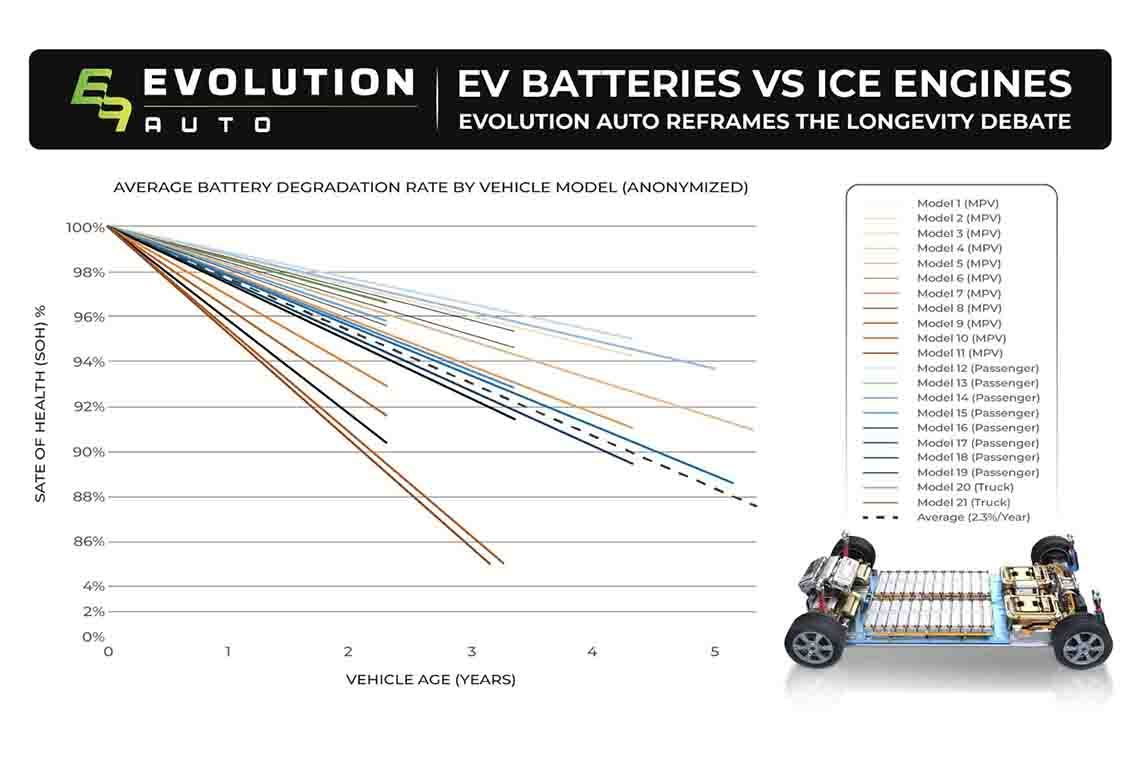
Global research conducted by Geotab, based on data from more than 22,700 electric vehicles across multiple brands and geographies, provides measurable clarity.
According to the study, the average yearly degradation rate of EV batteries is just 2-3%.
After eight years of use, the majority of batteries maintain more than 80% of their original capacity at this rate.
Importantly, the research shows that battery deterioration occurs gradually rather than abruptly.
Many modern EV batteries are predicted to remain over 70% capacity for 15 to 20 years based on observed deterioration trend lines; this benchmark is frequently regarded as the functional threshold for usable automotive performance.
Practically speaking, this implies that the battery may frequently outlive the vehicle's typical ownership lifecycle.
The study further highlights that while moderate climates and effective thermal management systems greatly preserve battery health, prolonged exposure to intense heat might accelerate degradation.
More recent EV generations have better long-term durability than earlier models thanks to improvements in battery chemistry and management software.
These findings support the idea that modern EV battery systems are engineered for consistent performance, predictable aging, and long-term use, shifting the focus of the longevity discussion from concern to measurable engineering evidence.
By contrast, ICE vehicles inevitably experience wear across multiple interconnected systems, including engines, gearboxes, exhaust assemblies, fuel injection systems, clutches, and cooling mechanisms.
As these systems age, maintenance complexity and costs typically increase.
In contrast to battery degradation, which is often progressive and quantifiable, mechanical wear in ICE vehicles can occur randomly across multiple components at once.
Electric vehicles do not have many of the components that often characterize long-term mechanical deterioration in combustion vehicles.
EVs offer a fundamentally different ownership profile, one that is centered on gradual and predictable battery aging rather than cumulative mechanical breakdown, because they have significantly fewer moving parts and no combustion process.
This structural simplicity modifies the evaluation of longevity.
The main focus of EV ownership is a battery system that is designed to degrade slowly and consistently over time, as opposed to maintaining multiple high-wear mechanical systems.
Speaking on the matter, Nuran Silva, Head of After Sales at Evolution Auto, stated:
“The comparison is evident when we evaluate long-term ownership for both technologies.
While ICE vehicles experience progressive wear across multiple mechanical systems simultaneously, EV batteries degrade gradually and predictably.
Modern electric vehicles have a more consistent long-term performance profile, based on our direct after-sales experience supporting customers through both platforms.
Battery life is no longer what was originally thought to be the limiting factor.”
The after-sales operations of Evolution Auto manage vehicles on both conventional and electric platforms, offering practical lifecycle insights based on customer experience rather than theoretical modeling.
Evolution Auto operates at scale across several EV brands and platforms, giving it direct access to real-world vehicle performance under a variety of driving conditions in Sri Lanka.
This perspective supports a more general industry reality: electric mobility has transitioned from early adoption uncertainty to measurable, data-driven durability.
Strong battery retention over long periods of time is confirmed by international research, and local operational experience shows consistent ownership patterns.
When taken as a whole, these factors help to clarify the overall lifespan of a vehicle.
The mobility landscape in Sri Lanka is changing.
Durability must be measured by engineering efficiency and long-term performance stability rather than mechanical complexity when consumers and businesses evaluate long-term vehicle investments.
More modern electric vehicles are proving that longevity may be achieved through simplicity.
EVs are proven to be able to meet and, in many cases, surpass the usable lifespan often associated with ICE vehicles thanks to battery systems designed for steady degradation and fewer high-wear mechanical components.
Electric mobility is no longer an experimental alternative; it is an established and durable solution ready for long-term ownership.
For more information, visit www.evolutionauto.lk or contact 0777 553 355.
This article references global EV battery performance research conducted by Geotab.
Readers can explore the full study and detailed findings here : https://www.geotab.com/blog/ev-battery-health/
Latest Posts










Video

K9 unit flown by Emirates SkyCargo to Zimbabwe begins frontline operations
Vega and Kuda, two specialist conservation dogs, transported by Emirates SkyCargo from London to Harare via Dubai in partnership with UK charity Dogs 4 Wildlife, have arrived safely and acclimatise